The profession of guide-lecturer
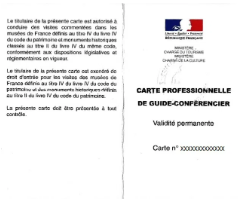
I hold the professional guide-lecturer card (No. GC 2271004P), which is mandatory for guiding visitors in museums and monuments of France. This is the proof that I followed specific training to be a guide in France.
I always wear this card prominently during guided tours, don't hesitate to ask me!
Heritage enhancement
Actor of cultural tourism, the tour guide-lecturer welcomes and accompanies tourists, individually or in groups, French or foreign, for the visit of an exhibition in a museum, the discovery of a site, even of a region. His comments, of quality and variety, bring a real plus to the visit. His performance can last an hour or several days if he accompanies a group on an excursion. He can also give lectures.
Extensive general culture
In order to make a visit attractive and to bring more than an audio-guide, the tour guide-lecturer captivates his audience with his extensive knowledge of history, art history, architecture, geography... He does in-depth research , especially if it offers a conference or if it is aimed at a specific audience. He has a sense of pedagogy to pass on his knowledge to all of his audience.
Access to the profession
In France, tour guide-lecturer is a regulated profession. To access it, you must have the Professional Guide-lecturer Card, which is issued by the Ministries of Culture and Tourism following a license or a master's degree. This card allows you to “lead guided tours in French museums and classified historical monuments” throughout France.
Since 2012, the term tour guide-lecturer has combined the terms guide-interpreter (national or regional), lecturer for towns and countries of art and history, national lecturer. We also sometimes speak of tourist guide, cultural guide or tour guide. Nevertheless, there is a difference between these professions: there is no specific diploma to be a guide, and a guide does not have the right to carry out guided tours in a museum or a monument during the trip that he comes with.
